ICICI Prudential AMC’s ₹10,602.65 crore IPO (Dec 12-16, 2025) was a full Offer for Sale (OFS), meaning the company did not receive IPO money. On listing day (Dec 19, 2025), the stock debuted at ₹2,600 on NSE versus the IPO price of ₹2,165, implying a 20% premium and a market cap of ₹1,28,507 crore. This blog breaks down the first-day signal, the post-IPO valuation, and what to track next as lock-ins approach
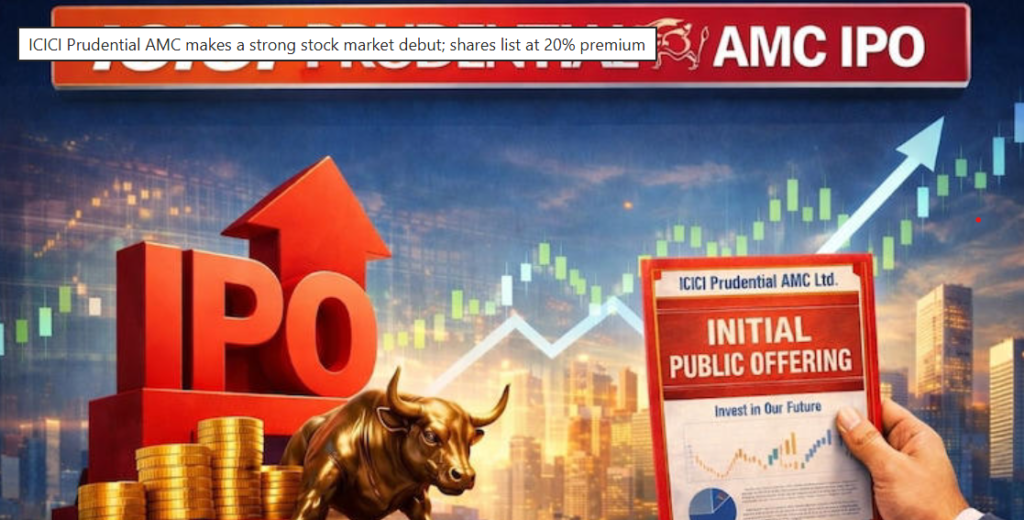
The listing of ICICI Prudential AMC has been slightly below the expectations. Ahead of its listing, shares of ICICI Prudential AMC were commanding a grey market premium (GMP) of Rs 520-530 apiece, suggesting a listing pop of 24 per cent for the investors. Its GMP was seen consistently rising since the closure of the issue.
Key Facts and First-Day Trends
- IPO Price: ₹2,165 per share
- Listing Price: ₹2,600 per share (20.09% above issue price on NSE)
- Market Capitalization (at listing): ~₹1,28,500 crore
The bidding part of the Rs 10,600-crore I-Pru MF IPO closed with nearly 55 lakh applicants, that got it a subscription of a little over 39 times. The large number of applications made the IPO one of the most subscribed offers in India ever, data from merchant bankers showed. Through this IPO, the UK-based Prudential Corp, the joint venture partner of ICICI Bank in the fund house, sold nearly 4.9 crore shares.
As of the listing price, retail investors, who got a single lot of six shares, made a profit of Rs 2,647.2 on their investment. Similarly, HNI shareholders, who got 15 lots consisting of 90 equity shares, made a profit of Rs 39,708 on their investment of Rs 2,07,840. Eligible shareholders of ICICI Bank, who made full application of 90 shares and got 9 or 10 shares, made a profit of Rs 3,970.2 or Rs 4,412.
The IPO of ICICI Prudential AMC was open for bidding between December 12 and December 16. It had offered its shares in the price band of Rs 2,061-2,165 per share with a lot size of six shares. It raised a total of Rs 10,602.65 crore via IPO, which was entirely an offer-for-sale (OFS) up to 4,89,72,994 equity shares by Prudential Corp (UK).
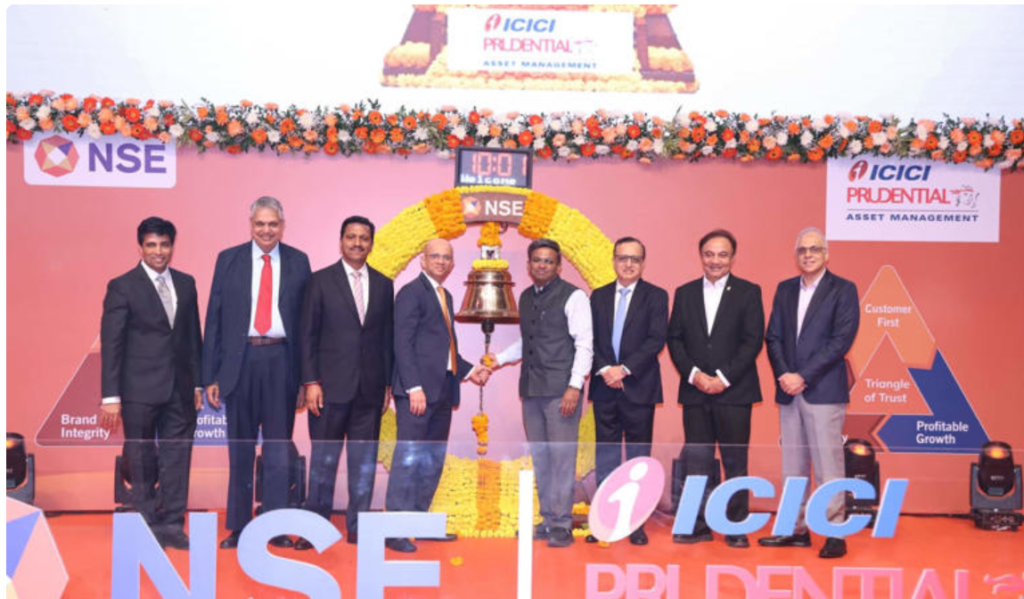
The issue was overall subscribed a total of 39.17 times, attracting bids nearly Rs 2.97 lakh crore through more than 55.07 lakh applications. It became the fourth highest subscribed IPO of Indian history and 19 out of 20 domestic mutual funds participated in its anchor book.
Incorporated in 1993, Mumbai-based ICICI Prudential AMC is an asset management company, whose investment approach has been to manage risk first and aim for long term returns for their customers. It has an active quarterly average asset under management (QAAUM). As of September 30, 2025, it has an QAAUM of 10,147.6 billion.
Analysts and brokerage firms continue to remain positive on the stock and see this as a long-term bet. Citigroup Global Markets India, Goldman Sachs (India), ICICI Securities, Morgan Stanley India, BofA Securities, Avendus Capital, Axis Capital, BNP Paribas and CLSA India are among the 18 the book running lead manager and Kfin Technologies is the registrar of the issue.
Post-IPO Valuation Check
- At IPO price ₹2,165, the stock was valued at ~33x P/E (price-to-earnings, what you pay for ₹1 of annual profit) on annualized H1 FY26 earnings.
- At listing market cap ₹1,28,507 crore, the P/E on H1 FY26 profit (annualized) works out to ~40x, so valuation moved up versus the IPO level.
- Equirus Securities (report dated Dec 17, 2025) has a BUY (LONG) view with a target price of ₹2,900, mainly citing high profitability, strong equity mix, and SIP-led flows.
- NDTV Profit reported Prabhudas Lilladher’s ‘buy’ rating with a target price of ₹3,000, and also said the IPO valuation looked like a discount versus HDFC AMC (45x) and Nippon Life India AMC (41x) at the IPO price.
- Anand Rathi’s Narendra Solanki said the company looked “fairly valued” around ~40x FY25 P/E and suggested allotted investors may continue to hold for medium to long post listing, supported by SIP flows and industry financialisation.
Should You Hold or Sell Now?
- Short-term trader: a 20% listing premium often brings fast profit-booking risk, so it can help to watch if the price holds above ₹2,600 after early volatility and near the first few closes.
- Medium-term investor: with valuation now higher than the IPO (P/E moved up meaningfully), the key question becomes whether AUM growth and fee stability can “catch up” to the price over the next few quarters.
- Long-term investor: the business is asset-light with a very high ROE of about 82.8%, but returns are still tied to market cycles and fee pressure, so patience is usually tested in down-market phases.
- Balanced action: if sitting on listing gains, consider whether partial profit-booking fits risk comfort, especially ahead of lock-in expiries that can add supply temporarily.
What Investors Should Track Now
- Quarterly results: track total income and profit trend versus FY25 (₹4,979.67 crore income; ₹2,650.66 crore profit) and H1 FY26 momentum (₹2,949.61 crore income; ₹1,617.74 crore profit).
- Anchor lock-in expiry dates: Jan 15, 2026 (30-day) and Mar 16, 2026 (90-day) are key supply events; selling pressure of 5-15% is common around such expiries.
- Equity mix and equity yields: brokers are positive because equity funds usually earn higher fees than debt funds, so watch if the equity share stays strong and whether fee yield holds up as competition rises.
- SIP flow momentum: the “steady monthly inflow” story matters because it can smoothen AUM swings, so check monthly/quarterly flow commentary and market share in equity flows.
- Non-mutual fund revenue: NDTV Profit highlighted a higher non-MF revenue share as a positive, so track alternates (PMS/AIF) growth and whether it improves the quality of earnings.
- SEBI and pricing risk: if fee rules tighten (TER cuts) or more money shifts to low-cost products, profit growth can slow even if AUM rises, so watch management guidance on pricing and distributor payouts.